
Growing backyard strawberries is as much a part of summer as lazy days, fireflies, baseball, and the smell of cut grass. If you keep things simple, strawberries are as easy to grow as any backyard vegetable.
This article contains affiliate links, and any purchases made through those links may result in a small commission. Buying guide at end of article.
Although the strawberry plant is a perennial, we treat them as annual plants just like tomatoes. The bare-root strawberries are planted in April, and once the strawberries have finished fruiting (usually late September in our area), the plants are removed from the bed and composted. We plant new bare root strawberry plants the following spring. We're in Zone 5, and this system just ended up working best for our limited space, as well as the time constraints involved with finding runners and overwintering the plants.
Don't overcomplicate this. If you're planting the strawberries as annuals, simply choose a proven producer for your area and go with it. Search for bare-root strawberry plants (your USDA Zone), or maybe use your zip code. We went with Ozark Beauty (everbearing) the first year and it's been a trouble-free, solid producer every time we've planted them. Pretty much all strawberry varieties produce harvestable fruits roughly 30 days after bloom.
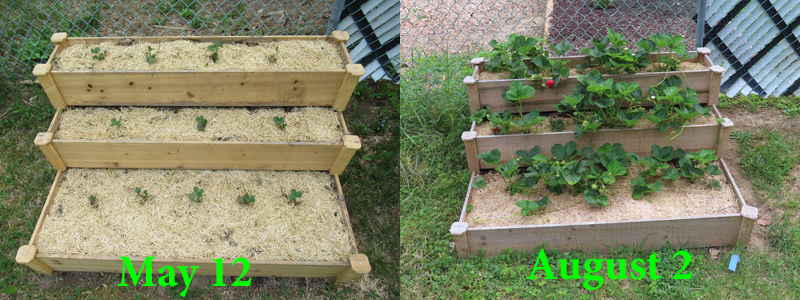
The image below shows the Ozark Beauty strawberry plants a couple of weeks after planting (May 12) and a few months later (August 2). We started picking ripe strawberries in June so there aren't many strawberries in the August picture because we harvest the ripe fruits on a daily basis.
Assuming this is your first time growing strawberries (you're reading a beginner's guide), here are a few basic tips for planting strawberries. If you're planting them as perennials the same process applies, but you'll need to give much more thought to the planting location.
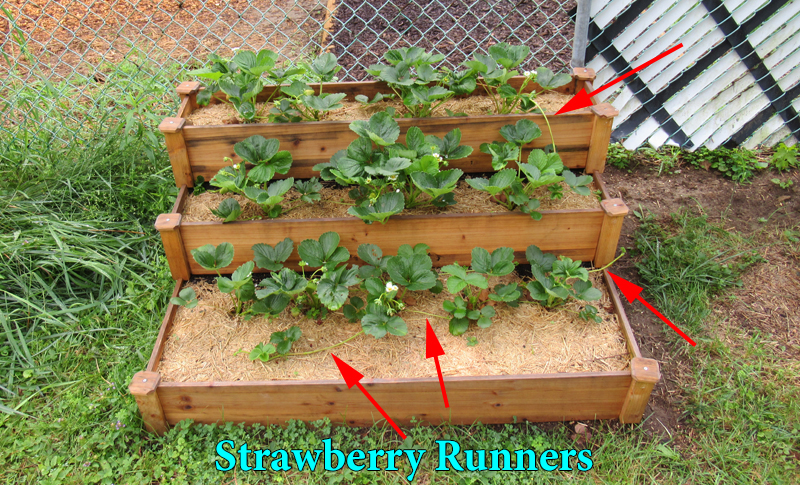
Like any other plant, the strawberry's goal isn't to provide us with luscious strawberries - their primary goal is to ensure survival by extending their root system. Strawberries do this by sending out runners, (aka daughter plants), and some of those runners will take root and produce a new strawberry plant. Sounds like free strawberry plants, right? Yes, but it comes at a price. Focusing their energy on extending the roots takes energy away from fruit production and you'll end up with very small strawberries that can be difficult to find under the strawberry's leaf canopy. Because we grow them as annuals we cut all the runners early on, and growing the strawberries in a raised bed makes this process very easy.
The red arrows in the image below shows some of the runners.
Almost all plants benefit from mulch, but because strawberries grow low to the ground and have a fairly shallow root system, it's even more important to mulch the plants right after they're planted to help keep the roots cool and consistently moist. Mulch also keeps the fruits clean, and helps prevent slimy slugs from reaching the sweet fruits. We've found chopped straw to be the best mulch, but anything is better than nothing. We've never used them, but they make strawberry racks that get positioned around the plant to raise the fruits off the ground, so that might be another option.
Occasionally the big box stores and/or local garden centers carry strawberry seeds, but not usually the bare-root plants. We've had good luck so far with strawberry plants bought from Amazon so here's a link for the Ozark Beauty bare-root plants. This is the 3-tier raised bed planter shown in the article, and this is a large bale of chopped mulch. Another popular option for growing strawberries is a 5-tier vertical planter, and finally here are the strawberry planter racks which might work better than the mulch for your growing situation. Give the strawberries a shot and good luck with your harvest!!
Here's a video that follows our Ozark Beauty strawberries from bare-roots to fruiting: